Report a question
ముఖ్య సూచనలు (Important Instructions) అభ్యర్థులు పరీక్ష ప్రారంభించే ముందు ఈ క్రింది నియమాలను జాగ్రత్తగా చదవండి: ప్రశ్నల సంఖ్య: ఈ పరీక్షలో మొత్తం 50 బహుళ ఐచ్ఛిక ప్రశ్నలు (MCQs) ఉంటాయి. సమయ పరిమితి: పరీక్షకు కేటాయించిన సమయం 50 నిమిషాలు. స్క్రీన్ పైన టైమర్ను గమనిస్తూ ఉండండి. ఆటోమేటిక్ సబ్మిషన్: 50 నిమిషాల సమయం ముగియగానే, మీరు సబ్మిట్ చేయకపోయినా మీ సమాధానాలు ఆటోమేటిక్గా సేవ్ చేయబడతాయి.
నావిగేషన్:
తర్వాతి ప్రశ్నకు వెళ్లడానికి 'Next' బటన్ నొక్కండి.
మునుపటి ప్రశ్నకు వెళ్లి సమాధానం మార్చుకోవడానికి 'Previous' బటన్ ఉపయోగించవచ్చు. సందేహాలు/ఫిర్యాదులు: ఏదైనా ప్రశ్నపై సందేహం ఉంటే, ఆ ప్రశ్న కింద ఉన్న **'Complaint Box'**లో తెలియజేయవచ్చు.
ఫలితాలు & : * పరీక్ష పూర్తయిన వెంటనే మీ మార్కులు (Marks) స్క్రీన్ పై కనిపిస్తాయి.
గమనిక: పరీక్ష మధ్యలో పేజీని 'Refresh' చేయకండి. ఈ పరీక్షలపై అభిప్రాయాలను తప్పకుండా తెలియచేయండి. మా వెబ్సైటు subscribe చేసుకోండి. ప్రతి పరీక్ష upload చేసిన వెంటనే మీకు నోటిఫికేషన్ వస్తుంది. ఆల్ ది బెస్ట్ & press START
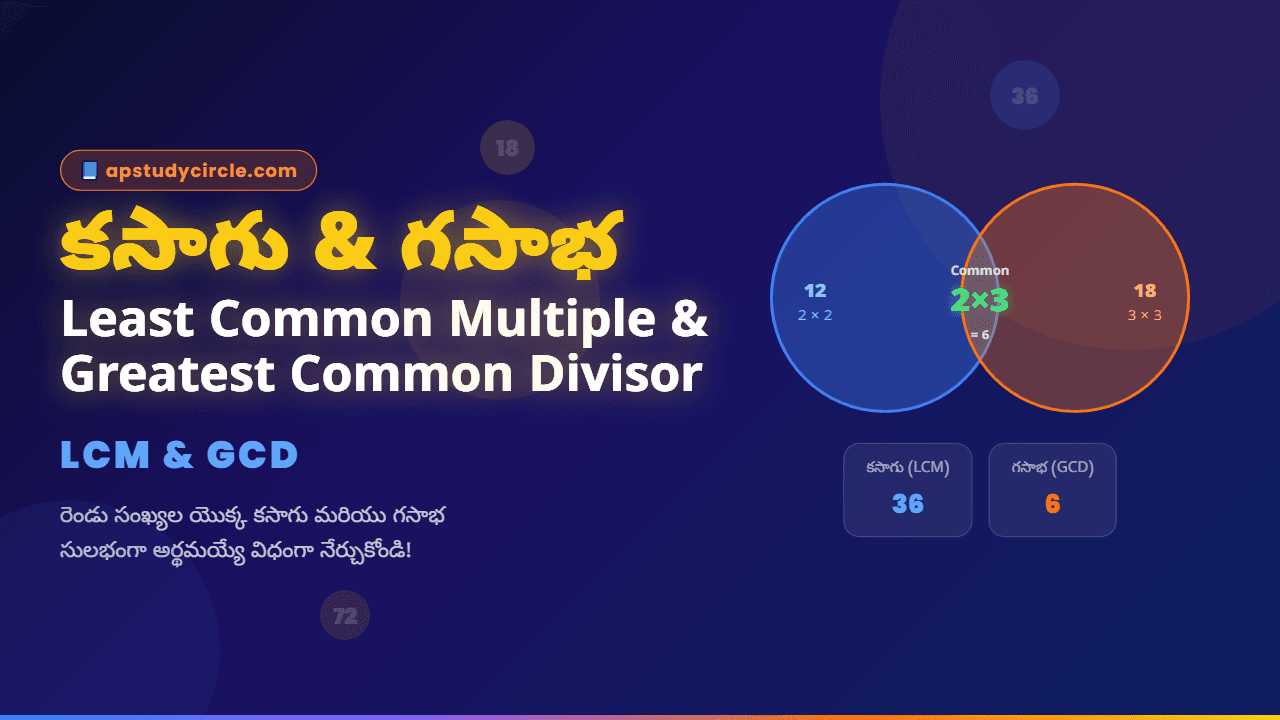
LCM and GCD క సా గు మరియు గ సా బా
2 / 50
2. జతపరచండి: HCF మరియు LCM – రెండు సంఖ్యలు కనుగొనడం
Column A: 1. HCF=4, LCM=48, ఒక సంఖ్య=12; రెండవది=? 2. HCF=6, LCM=72, ఒక సంఖ్య=18; రెండవది=? 3. HCF=5, LCM=100, ఒక సంఖ్య=25; రెండవది=? 4. HCF=3, LCM=90, ఒక సంఖ్య=9; రెండవది=?
Column B: i. 20 ii. 16 iii. 24 iv. 30
Match: Finding Numbers from HCF and LCM
Column A: 1. HCF=4,LCM=48,one=12; other? 2. HCF=6,LCM=72,one=18; other? 3. HCF=5,LCM=100,one=25; other? 4. HCF=3,LCM=90,one=9; other?
Column B: i. 20 ii. 16 iii. 24 iv. 30
A. A) 1-i, 2-iii, 3-iv, 4-ii
B. C) 1-ii, 2-iii, 3-i, 4-iv
C. D) 1-iv, 2-i, 3-iii, 4-ii
D. B) 1-iii, 2-iv, 3-ii, 4-i
Other number = HCF×LCM / known number. 4×48/12=16. 6×72/18=24. 5×100/25=20. 3×90/9=30.
రెండవ సంఖ్య = HCF×LCM / తెలిసిన సంఖ్య. 48×4/12=16. 72×6/18=24. 100×5/25=20. 90×3/9=30.
7 / 50
7. 1 నుండి 20 వరకు అన్ని సంఖ్యల LCM ఎంత?
What is the LCM of all numbers from 1 to 20?
Highest prime powers ≤ 20:
2⁴=16, 3²=9, 5¹=5, 7¹=7, 11,13,17,19
LCM = 16×9×5×7×11×13×17×19 = 232792560
తెలుగు: 20 కంటే తక్కువ లేదా సమాన prime శక్తులు:
2⁴, 3², 5, 7, 11, 13, 17, 19.
వాటి లబ్ధం = 232792560.
9 / 50
9. జతపరచండి: HCF–LCM అనుప్రయోగాలు
Column A: 1. రెండు సంఖ్యలు 12, 18. HCF=6 అయితే LCM=? 2. LCM=60, HCF=5, ఒక సంఖ్య 15 అయితే రెండవ సంఖ్య? 3. HCF=8, సంఖ్యల నిష్పత్తి 3:4, పెద్దది? 4. తక్కువ సమయంలో కలిసే కాలానికి LCM ఉపయోగం
Column B: i. 20 ii. 32 iii. 36 iv. కలిసే కాలం
Match: HCF-LCM Applications
Column A: 1. Numbers 12,18; HCF=6; LCM=? 2. LCM=60,HCF=5,one number=15; other=? 3. HCF=8, ratio 3:4; larger number? 4. When do they meet again?
Column B: i. 20 ii. 32 iii. 36 iv. LCM gives meeting time
A. B) 1-iv, 2-i, 3-iii, 4-ii
B. C) 1-iii, 2-i, 3-ii, 4-iv
C. A) 1-i, 2-iii, 3-ii, 4-iv
D. D) 1-ii, 2-iv, 3-i, 4-iii
LCM=HCF×product/HCF=12×18/6=36. Other number=LCM×HCF/15=60×5/15=20. Larger=8×4=32. LCM finds meeting time.
LCM=12×18/6=36. రెండవ సంఖ్య=60×5/15=20. పెద్దది=8×4=32. కలిసే సమయానికి LCM వాడతాం.
14 / 50
14. జతపరచండి: భాగింత సంఖ్యల నమూనాలు
Column A: 1. 4,6 రెండింటిచే భాగింపబడే అతి చిన్న 3 అంకెల సంఖ్య 2. 7,11 లకు HCF 3. 12,15,20 లకు LCM 4. 17,19 కి HCF
Column B: i. 1 ii. 60 iii. 108 iv. 1
Match: Divisibility Patterns
Column A: 1. Smallest 3-digit divisible by 4,6 2. HCF(7,11) 3. LCM(12,15,20) 4. HCF(17,19)
Column B: i. 1 ii. 60 iii. 108 iv. 1
A. D) 1-iii, 2-i, 3-ii, 4-iv
B. B) 1-iv, 2-ii, 3-i, 4-iii
C. A) 1-ii, 2-iii, 3-iv, 4-i
D. C) 1-i, 2-iv, 3-iii, 4-ii
LCM(4,6)=12; smallest 3-digit=108. HCF(7,11)=1 (co-primes). LCM(12,15,20)=60. HCF(17,19)=1 (both primes).
LCM(4,6)=12; 3 అంకెల చిన్నది=108. 7,11 సహ-అభాజ్యాలు కాబట్టి HCF=1. LCM(12,15,20)=60. 17,19 అభాజ్యాలు కాబట్టి HCF=1.
16 / 50
16. ఒక సంఖ్య యొక్క సన్నిహిత కారణాంకాల (n మరియు n+1 రూపంలో) జత ఉందా? GCD మరియు LCM వివరించండి.
Do consecutive divisors (form n, n+1) exist for any number? Explain using GCD and LCM.
If n and n+1 both divide N, then LCM(n,n+1) must divide N.
Since GCD(n,n+1)=1, LCM(n,n+1) = n(n+1).
So n(n+1) | N — N must be a multiple of n(n+1).
Example: N=12, divisors include 3 and 4 → LCM(3,4)=12 divides 12 ✓
తెలుగు: n మరియు n+1 రెండూ N ని భాగిస్తే, n(n+1) కూడా N ని భాగించాలి.
ఉదా: 12 ని 3 మరియు 4 రెండూ భాగిస్తాయి → LCM(3,4)=12 | 12 ✓.
18 / 50
18. రెండు సంఖ్యల LCM వాటి మొత్తానికి 3 రెట్లు, GCD = 8. అతి చిన్న జత?
LCM = 3 times the sum of two numbers. GCD=8. Find smallest pair.
a=8x, b=8y (co-prime x,y), LCM=8xy, sum=8(x+y)
8xy = 3×8(x+y) → xy = 3(x+y)
xy - 3x - 3y = 0 → (x-3)(y-3) = 9
Pairs: (4,12) since (x-3,y-3)=(1,9) → x=4, y=12
Numbers: a=32, b=96
తెలుగు: (x-3)(y-3)=9 → x=4, y=12 → సంఖ్యలు 32 మరియు 96.
Check: LCM(32,96)=96, sum=128, 96=3×32 ✗...
LCM=96, 3×(32+96)=3×128=384≠96. Let me recheck: a=32,b=96,LCM=96,sum=128,3×sum=384≠LCM.
Correct: x=4,y=12: a=32,b=96, LCM=8×4×12=384, sum=128, 3×128=384 ✓
19 / 50
19. మూడు సంఖ్యల మొత్తం 108, అవి 2:3:4 నిష్పత్తిలో ఉన్నాయి. వాటి LCM ఎంత?
Sum of three numbers = 108, ratio 2:3:4. Find their LCM.
Numbers = 2k, 3k, 4k → sum = 9k = 108 → k = 12
Numbers = 24, 36, 48
LCM(24,36,48): 24=2³×3, 36=2²×3², 48=2⁴×3
LCM = 2⁴×3² = 144
తెలుగు: 2k+3k+4k = 9k = 108 → k = 12.
సంఖ్యలు 24, 36, 48.
LCM(24,36,48) = 2⁴×3² = 144.
22 / 50
22. GCD(a², b²) = (GCD(a,b))². ఇది నిజమా? a=6, b=10 తో verify చేయండి.
Is GCD(a²,b²) = (GCD(a,b))²? Verify with a=6, b=10.
GCD(6,10) = 2 → (GCD)² = 4
GCD(36, 100): 36=2²×3², 100=2²×5² → GCD=2²=4 ✓
So GCD(a²,b²) = (GCD(a,b))² is TRUE
తెలుగు: GCD(a,b)=2 → (GCD)²=4.
GCD(36,100)=4 → రెండూ సమానం ✓.
ఈ గుణం నిజమే: GCD(a²,b²) = [GCD(a,b)]².
23 / 50
23. LCM(a,b) × GCD(a,b) = a × b ను నిరూపించడానికి ఏ method వాడతారు?
Which method proves LCM(a,b) × GCD(a,b) = a × b?
Using Prime Factorization:
For each prime p: max(α,β) + min(α,β) = α + β
where a = ∏p^α, b = ∏p^β
LCM uses max powers, GCD uses min powers → their product = a×b
తెలుగు: Prime factorization method వాడి నిరూపించవచ్చు.
ప్రతి prime కు: max + min = α + β.
కాబట్టి LCM × GCD = a × b.
ఉదా: a=12=2²×3, b=18=2×3² → LCM=36, GCD=6 → 36×6=216=12×18 ✓
27 / 50
27. సంఖ్యను 3, 5, 7 లతో భాగించినా వరుసగా 1, 3, 5 శేషాలు వస్తే అతి చిన్న సంఖ్య?
Remainders are 1,3,5 when divided by 3,5,7. Find smallest such number.
x ≡ 1 (mod 3), x ≡ 3 (mod 5), x ≡ 5 (mod 7)
Try x = 103: 103÷3=34 R1 ✓ | 103÷5=20 R3 ✓ | 103÷7=14 R5 ✓
తెలుగు: ఒక్కో condition పరీక్షించాలి.
x=103: 3తో భాగిస్తే 1 శేషం ✓, 5తో భాగిస్తే 3 శేషం ✓, 7తో భాగిస్తే 5 శేషం ✓.
30 / 50
30. రెండు సంఖ్యల మొత్తం 528, GCD 24. అటువంటి జతలు ఎన్ని సాధ్యం?
Sum of two numbers=528, GCD=24. How many such pairs exist?
Let numbers = 24x and 24y, GCD(x,y)=1, x+y = 528/24 = 22
Co-prime pairs (x,y) with x+y=22: (1,21),(3,19),(5,17),(7,15),(9,13) = 5 pairs
తెలుగు: సంఖ్యలు 24x మరియు 24y అనుకోండి, x+y=22.
x మరియు y co-prime అయిన జతలు: 5 జతలు.
32 / 50
32. జతపరచండి: ప్రధాన కారణాంక విభజన – HCF
Column A: 1. 36=2²×3², 48=2⁴×3; HCF=? 2. 84=2²×3×7, 90=2×3²×5; HCF=? 3. 72=2³×3², 120=2³×3×5; HCF=? 4. 45=3²×5, 75=3×5²; HCF=?
Column B: i. 6 ii. 12 iii. 15 iv. 24
Match: Prime Factorisation – HCF
Column A: 1. 36,48 2. 84,90 3. 72,120 4. 45,75
Column B: i. 6 ii. 12 iii. 15 iv. 24
A. B) 1-iv, 2-i, 3-ii, 4-iii
B. D) 1-i, 2-iv, 3-iii, 4-ii
C. C) 1-ii, 2-iii, 3-iv, 4-i
D. A) 1-iii, 2-i, 3-iv, 4-ii
HCF=product of common prime factors with lowest powers. 36,48: HCF=2²×3=12. 84,90: HCF=2×3=6. 72,120: HCF=2³×3=24. 45,75: HCF=3×5=15.
HCF=ఉమ్మడి ప్రధాన కారణాంకాల లబ్ధం (తక్కువ ఘాతాంకాలతో). 36,48:12. 84,90:6. 72,120:24. 45,75:15.
34 / 50
34. GCD(2^12 - 1, 2^8 - 1) ఎంత? (Formula: GCD(2^m-1, 2^n-1) = 2^GCD(m,n)-1)
Find GCD(2^12 - 1, 2^8 - 1).
Formula: GCD(2^m - 1, 2^n - 1) = 2^GCD(m,n) - 1
GCD(12, 8) = 4
Therefore GCD(2^12-1, 2^8-1) = 2^4 - 1 = 15
తెలుగు: ముందు GCD(12,8) = 4 కనుగొనాలి.
తర్వాత 2⁴ - 1 = 15.
Check: 2^12-1=4095, 2^8-1=255, GCD(4095,255)=15 ✓
36 / 50
36. జతపరచండి: HCF మరియు LCM సంబంధాలు
Column A: 1. రెండు సంఖ్యల లబ్ధం 2. అభాజ్య సంఖ్యల HCF 3. సహ-అభాజ్యాల LCM 4. HCF × LCM
Column B: i. రెండు సంఖ్యల లబ్ధానికి సమానం ii. వాటి లబ్ధం iii. 1 iv. 1
Match: HCF-LCM Relations
Column A: 1. Product of two numbers 2. HCF of primes 3. LCM of co-primes 4. HCF × LCM
Column B: i. Equals product of numbers ii. Their product iii. 1 iv. 1
A. C) 1-iv, 2-iii, 3-i, 4-ii
B. B) 1-iii, 2-i, 3-ii, 4-iv
C. A) 1-ii, 2-iv, 3-iii, 4-i
D. D) 1-i, 2-ii, 3-iv, 4-iii
Product of two numbers = HCF × LCM. HCF of primes = 1 (no common factors). LCM of co-primes = their product. HCF × LCM = product of numbers.
రెండు సంఖ్యల లబ్ధం = HCF × LCM. అభాజ్యాల HCF=1. సహ-అభాజ్యాల LCM = వాటి లబ్ధం.
39 / 50
39. a, b, c లు పరస్పర co-prime అయితే LCM(ab, bc, ca) ఎంత?
If a, b, c are pairwise co-prime, what is LCM(ab, bc, ca)?
Since a,b,c are pairwise co-prime, each prime appears in at most one of them.
ab contains primes of a and b
bc contains primes of b and c
ca contains primes of c and a
LCM = all primes together = abc
తెలుగు: a,b,c పరస్పర co-prime కాబట్టి వాటి prime factors వేర్వేరు.
ab, bc, ca మూడింటిలో కలిసిన prime factors = a, b, c అన్నీ.
LCM = abc.
ఉదా: a=2,b=3,c=5 → LCM(6,15,10) = 30 = 2×3×5 ✓
40 / 50
40. ఒక సంఖ్యను 5, 6, 7, 8 లతో భాగించినా 3 శేషం వస్తే అతి చిన్న 4 అంకెల సంఖ్య?
Remainder is 3 when divided by 5,6,7,8. Smallest 4-digit such number?
LCM(5,6,7,8) = 840
Numbers = 840k + 3
k=1 → 843 (3 digits)
k=2 → 1683 (4 digits!) ✓
తెలుగు: 5,6,7,8 కు 3 శేషం వచ్చే సంఖ్యలు = 840k+3.
843 మూడు అంకెలు, 1683 నాలుగు అంకెలు → 1683.
Check: 1683÷5=336R3 ✓|÷6=280R3 ✓|÷7=240R3 ✓|÷8=210R3 ✓
46 / 50
46. ఒక సంఖ్యను 6, 7, 8 లతో భాగించినా 2 శేషం వస్తే, అతి చిన్న 3 అంకెల సంఖ్య ఏది?
A number gives remainder 2 when divided by 6, 7, 8. Find smallest 3-digit such number.
Numbers of this type = LCM(6,7,8) × k + 2
LCM(6,7,8) = 168
k=1 → 170 (3 digits!) ✓
తెలుగు: 6, 7, 8 లతో భాగించినా 2 శేషం వచ్చే సంఖ్యలు = 168k + 2.
k=1 → 170 అనేది మొదటి 3 అంకెల సంఖ్య.
47 / 50
47. GCD(a,b) = 1 అయితే GCD(a+b, ab) ఎంత?
If GCD(a,b)=1, what is GCD(a+b, ab)?
If GCD(a,b)=1 (co-prime), then:
Any prime p dividing both (a+b) and ab must divide a or b.
If p|a and p|(a+b) then p|b → contradiction since GCD(a,b)=1.
Therefore GCD(a+b, ab) = 1
తెలుగు: a మరియు b co-prime అయితే (a+b) మరియు ab కూడా co-prime.
ఉదా: a=3, b=5 → a+b=8, ab=15 → GCD(8,15)=1 ✓
49 / 50
49. p మరియు q co-prime. p|n మరియు q|n అయితే pq|n అని చెప్పే theorem ఏది?
If p,q are co-prime, p|n and q|n, then pq|n. Which theorem states this?
This is a corollary of the Chinese Remainder Theorem (CRT).
Also follows from: if GCD(p,q)=1, LCM(p,q)=pq, and both p,q divide n → pq divides n.
తెలుగు: p మరియు q co-prime, రెండూ n ని భాగిస్తే, pq కూడా n ని భాగిస్తుంది.
ఇది Chinese Remainder Theorem యొక్క consequence.
ఉదా: 4|60 మరియు 9|60, GCD(4,9)=1 → 36|60? 60÷36 = 1R24 ✗ — correct example: 4|36, 9|36, 36|36 ✓
50 / 50
50. 6 మరియు 9 యొక్క LCM ఎంత?
What is the LCM of 6 and 9?
6 = 2 × 3 | 9 = 3² → LCM = take highest powers → 2¹ × 3² = 18
తెలుగు: Prime factorization లో అత్యధిక శక్తులు తీసుకోవాలి.
2 ఒకసారి, 3 రెండుసార్లు వస్తుంది → LCM = 18.
Restart quiz
Download PDF
Post Views: 108