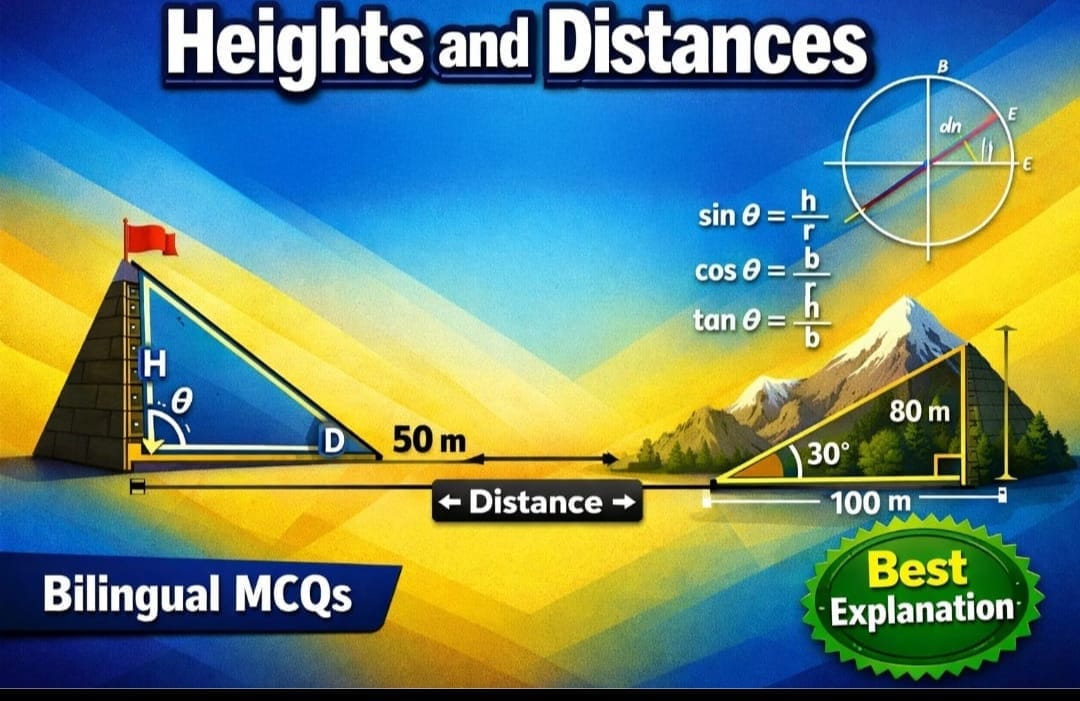
Heights & Distances (ఎత్తు మరియుదూరం )

Heights & Distances (ఎత్తు మరియుదూరం )

Report a question

You cannot submit an empty report. Please add some details.

​ముఖ్య సూచనలు (Important Instructions)

​అభ్యర్థులు పరీక్ష ప్రారంభించే ముందు ఈ క్రింది నియమాలను జాగ్రత్తగా చదవండి:

​ప్రశ్నల సంఖ్య: ఈ పరీక్షలో మొత్తం 50 బహుళ ఐచ్ఛిక ప్రశ్నలు (MCQs) ఉంటాయి.

​సమయ పరిమితి: పరీక్షకు కేటాయించిన సమయం 50 నిమిషాలు.

స్క్రీన్ పైన టైమర్‌ను గమనిస్తూ ఉండండి.

​ఆటోమేటిక్ సబ్మిషన్: 50 నిమిషాల సమయం ముగియగానే, మీరు సబ్మిట్ చేయకపోయినా మీ సమాధానాలు ఆటోమేటిక్‌గా సేవ్ చేయబడతాయి.
​నావిగేషన్:
​తర్వాతి ప్రశ్నకు వెళ్లడానికి 'Next' బటన్ నొక్కండి.
​మునుపటి ప్రశ్నకు వెళ్లి సమాధానం మార్చుకోవడానికి 'Previous' బటన్ ఉపయోగించవచ్చు.

​సందేహాలు/ఫిర్యాదులు: ఏదైనా ప్రశ్నపై సందేహం ఉంటే, ఆ ప్రశ్న కింద ఉన్న **'Complaint Box'**లో తెలియజేయవచ్చు.

ఫలితాలు & : * పరీక్ష పూర్తయిన వెంటనే, See result నొక్కండి. మీ మార్కులు (Marks) మరియు మీ ప్రశ్నాపత్రం జవాబులతో స్క్రీన్ పై కనిపిస్తాయి.
​  
​గమనిక: పరీక్ష మధ్యలో పేజీని 'Refresh' చేయకండి. 

ఈ పరీక్షలపై  అభిప్రాయాలను తప్పకుండా తెలియచేయండి. మా వెబ్సైటు subscribe  చేసుకోండి.ప్రతి పరీక్ష upload చేసిన వెంటనే మీకు నోటిఫికేషన్ వస్తుంది.  ఆల్  ది బెస్ట్ & PRESS  Start


Heights & Distances (ఎత్తు మరియుదూరం)

1 / 50

1. Tower casts 40 m shadow when sun elevation = 30°. Tower height?
Shadow=40m, elevation=30°. Height?

2 / 50

2. Sine rule in height problems: non-right triangles. Tower AB, observer C. ∠ACB=θ, BC=a, ∠BAC=α. AB=?
In triangle ABC: ∠ACB=θ, BC=a, ∠BAC=α. Find AB using sine rule.

3 / 50

3. Pole height = 6 m, shadow = 6 m. Elevation angle of sun?
Pole=6m, shadow=6m. Sun angle?

4 / 50

4. Person walks 20 m towards tower. Elevation changes from 30° to 45°. Tower height?
Elevation changes 30° to 45° walking 20m closer. Height?

5 / 50

5. Tree of height 10√3 m casts shadow 10 m. Angle of elevation of sun?
Tree=10√3 m, shadow=10m. Sun's elevation?

6 / 50

6. Sun's angle of elevation = 45°. Pole height = 12 m. Shadow length?
Sun elevation=45°, pole=12m. Shadow?

7 / 50

7. Star at elevation θ. Earth radius R. Observer height h. True altitude?
Observer at height h (above sea level), sees star at elevation θ. Atmospheric refraction ignored. True altitude from center?

8 / 50

8. Square base tower. From midpoint of side, elevation = α. From corner, elevation = β. If α > β, prove tanβ = tanα/√2... adjust.
From midpoint of base side: elevation=α. From corner: elevation=β. tanα/tanβ=?

9 / 50

9. Tower 60 m high. From bottom angle of elevation of cloud = 30°, reflection in lake = 60°. Cloud height above lake?
Tower=60m, elevation to cloud=30°, reflection=60°. Cloud height above lake?

10 / 50

10. Angle of elevation of cloud from point 60 m above lake = 30°. Angle of depression of its reflection = 60°. Height of cloud above lake?
60m above lake: cloud elevation=30°, reflection depression=60°. Cloud height?

11 / 50

11. Two poles heights 6 m and 11 m, 12 m apart. Wire joining tops. Wire length?
Poles 6m and 11m, 12m apart. Wire between tops?

12 / 50

12. Person at sea level sees cliff top at 60°, cliff foot at 30° (cliff on hill). If sea-to-hill base = 400 m, cliff height?
Sea level: cliff top=60°, hill base=30°. Sea to hill=400m. Cliff height?

13 / 50

13. Ship is 100√3 m away from lighthouse. Angle of elevation of top = 30°. Height of lighthouse?
Ship 100√3 m away, elevation=30°. Lighthouse height?

14 / 50

14. Horizontal observer sees bird flying north at speed v m/s, constant height h. At t=0: elevation=α. At t=T: elevation=β. Find h in terms of v,T,α,β.
Bird flies north at v m/s, height h. Elevations α at t=0, β at t=T. Express h.

15 / 50

15. Aircraft flying at 1000 m height. Angle of depression to airport = 30°. Horizontal distance?
Aircraft height=1000m, depression=30°. Horizontal distance?

16 / 50

16. Two buildings h₁ and h₂ apart by distance d. From bottom of h₂, elevation of top of h₁ = α. h₁ cosec α = ?
From bottom of h₂: elevation to top of h₁=α. Express h₁/sinα.

17 / 50

17. Optimal angle of projection for maximum range on inclined plane (angle α to horizontal) = 45°+α/2. Derive briefly.
Optimal angle for max range on slope α?

18 / 50

18. From vertex of equilateral triangle, angle of elevation of top of vertical pole at centroid = 60°. Triangle side = a. Pole height?
Equilateral triangle side=a. Pole at centroid, elevation from vertex=60°. Height?

19 / 50

19. Cliff 150 m high. Two ships on sea, same side. Angles of depression 30° and 60°. Distance between ships?
Cliff=150m. Depressions 30° and 60° (same side). Ship distance?

20 / 50

20. From top of hill 200 m high, angles of depression of two boats = 30° and 45°. Distance between boats?
Hill=200m. Depressions to boats: 30° and 45°. Distance between boats?

21 / 50

21. Kite is flying at height 60 m. String makes 60° with ground. String length?
Kite height=60m, string angle=60°. String length?

22 / 50

22. From bank of river, elevation of tree on opposite bank = 60°. 4 m back, elevation = 30°. River width and tree height?
Elevations 60° and 30° from two points 4m apart. Width and height?

23 / 50

23. Person stands 40 m from building. Elevation to top = 60°, to bottom of flag = 45°. Flag height?
Building top elevation=60°, flag bottom=45°, distance=40m. Flag height?

24 / 50

24. Two towers of same height on either side of road (width 80 m). From middle of road, elevations = 30° each. Height?
Road=80m. From middle: elevations=30° to both towers. Height?

25 / 50

25. Isosceles triangle base 2a. From apex, angle of elevation of flag at midpoint of base = α. From base vertex, elevation = β. Flag height?
Isosceles triangle, apex to flag=α, vertex to flag=β. Flag height?

26 / 50

26. From ground, angle of elevation of cloud = 30°. Height of cloud = 100 m. Horizontal distance?
Cloud elevation=30°, height=100m. Distance?

27 / 50

27. Parallax method: Star elevation changes by p (parallax) when observer moves d km. Distance to star?
Parallax angle p (radians), baseline d. Star distance D?

28 / 50

28. Ship A at 30° elevation, Ship B at 45° elevation from lighthouse top 100 m. Same line, opposite sides. Distance AB?
Lighthouse=100m. Ship A=30°, Ship B=45° (opposite sides). Distance?

29 / 50

29. Angle of depression అంటే ఏమిటి?
What is angle of depression?

30 / 50

30. Tower leans at θ to vertical. From base: distance d, elevation α. From same side, distance 2d, elevation β. Tower height?
Leaning tower, angles α,β from d and 2d. Height in terms of d,α,β?

31 / 50

31. Window is 8 m above ground. Angle of depression to car = 60°. Distance of car from building?
Window 8m high, depression to car=60°. Car distance?

32 / 50

32. Height = 15 m, angle of elevation = 30°. Distance from base?
Height=15m, elevation=30°. Distance?

33 / 50

33. Angle of elevation = 45°, height = 50 m. Horizontal distance?
Elevation=45°, height=50m. Distance?

34 / 50

34. Tower foot నుండి 30 m దూరంలో elevation = 60°. Tower నుండి 60 m దూరంలో elevation = ?
Elevation=60° at 30m. Find elevation at 60m.

35 / 50

35. Gradient of hill = 1:5 (rise:run). Angle of inclination? (tanθ=1/5)
Hill gradient 1:5. Find angle of inclination.

36 / 50

36. Flagpole on top of building. From 30 m away: elevation to building top = 45°, flagpole top = 60°. Flagpole height?
Distance=30m. Building top=45°, flagpole top=60°. Flagpole height?

37 / 50

37. 30° angle of elevation వద్ద shadow length = 30 m. Tower height?
Angle=30°, shadow=30m. Tower height?

38 / 50

38. Angle of elevation of top of tower = 30°. Elevation of point halfway up tower = β. Prove tanβ = 1/√3 × 2.
From same point: elevation to top=30°, to halfway point=β. Prove tanβ.

39 / 50

39. Angle of elevation of sun changes from 30° to 60° over 2 hours. If shadow at 30° is 60m, shadow at 60°? Rate of change of shadow length?
Shadow at 30°=60m. Find shadow at 60° and rate of change.

40 / 50

40. Theodolite at O measures elevation to tower top T = θ₁ from ground. From point P (directly below T), elevation to T = 90°. OP = d. OT = ?
O on ground, T = tower top. From O: elevation=θ₁. OP=d (below T). Find OT.

41 / 50

41. Ladder of length 10 m makes 60° with ground. Height reached on wall?
Ladder=10m, angle with ground=60°. Height on wall?

42 / 50

42. θ₁ and θ₂ are angles of elevation from two ends of horizontal rod of length L to top of vertical pole. Pole height h = L/(cotθ₁+cotθ₂)... verify.
Pole h, rod L. Elevations θ₁,θ₂ from rod ends to pole top. Verify h=L/(cotθ₁+cotθ₂).

43 / 50

43. Two persons 1.6 m tall each. One on top of hill 40 m high, sees other at 30° depression. Distance?
Hill=40m. Person on top sees other person (1.6m tall) at 30° depression. Distance?

44 / 50

44. Tower height = 10 m, horizontal distance = 10 m. Angle of elevation = ?
Tower height=10m, distance=10m. Angle of elevation?

45 / 50

45. Angle of elevation of top of tree = 60°. Distance from tree = 20 m. Height?
Elevation=60°, distance=20m. Height of tree?

46 / 50

46. Aeroplane at 3000 m. Angles of depression of two ships (same side) = 60° and 45°. Distance between ships?
Height=3000m. Depressions 60° and 45°. Ship distance?

47 / 50

47. Helicopter at height 500 m. Angle of depression of two cars on road = 60° and 30° (same side). Distance between cars?
Height=500m. Depressions 60° and 30°. Car distance?

48 / 50

48. From top of tower h m, elevation of hilltop = 60°, depression of hill foot = 30°. Hill height?
Tower=h. From top: hilltop elevation=60°, hill foot depression=30°. Hill height?

49 / 50

49. Building height = 20 m. Shadow at noon = 20/√3 m. Sun's elevation?
Building=20m, shadow=20/√3 m. Sun angle?

50 / 50

50. Angle of elevation of plane from two points A and B (1 km apart, same line) = 60° and 30°. Height of plane?
Plane elevations 60° and 30° from A,B (1km apart). Height?

0%

Comments

No comments yet. Why don’t you start the discussion?

    Leave a Reply

    Your email address will not be published. Required fields are marked *